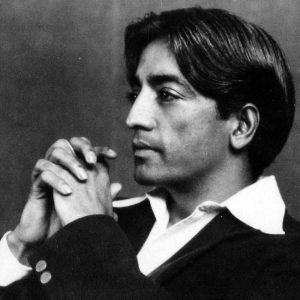
Born in India in 1895, Jiddhu Krishnamurti was brought up by the Theosophical Society who believed he was the teacher sent to bring about the World’s spiritual evolution. He fulfilled this role until the age of thirty four when he moved away from the Theosophical Society and took on an independent role as a teacher, speaker, author and philosopher.
Krishnamurti ‘s teachings span a wide range of subjects but he is particularly well known for his views on love, truth, freedom and young people. On truth, he maintained that you could not approach it by any path, such as religion, philosophy or sect.
“The moment you follow someone you cease to follow Truth. I am not concerned whether you pay attention to what I say or not….I am concerning myself with only one essential thing: to set man free. I desire to free him from all cages, from all fears, and not to found religions, new sects, nor to establish new theories and new philosophies.”
On love he wrote “Fear is not love, dependence is not love, jealousy is not love, possessiveness and domination are not love, responsibility and duty are not love, self-pity is not love, the agony of not being loved is not love, love is not the opposite of hate any more than humility is the opposite of vanity. If you can eliminate all these, not by forcing them but by washing them away as the rain washes the dust of many days from a leaf, then perhaps you will come upon this strange flower which man always hungers after.”
Freedom for Krishnamurti was internal – freedom from the past, false narratives, and social conditioning, the ability to still the mind and to be present without bias, without fear and attachment, expectations and conclusions. He also advocated freedom from tradition, gurus, and religion – freedom, he taught, is to find truth for yourself.
“Freedom is a state of mind – not freedom from something but a sense of freedom, a freedom to doubt and question everything and therefore so intense, active and vigorous that it throws away every form of dependence, slavery, conformity and acceptance.”
Krishnamurti was a pioneer in education, establishing schools across the world such as Brockwood Park School in Hampshire. He believed young people should be encouraged to think for themselves and to know themselves, not just to conform to the teachings of others. They were taught to ask questions, to avoid competition, and to understand themselves as a foundation for a peaceful, compassionate world.
“The highest function of education is to help the child to discover for himself what is true”.
“While one is young is the time to investigate, to experiment with everything”.
Books:
What are you doing with your life?